
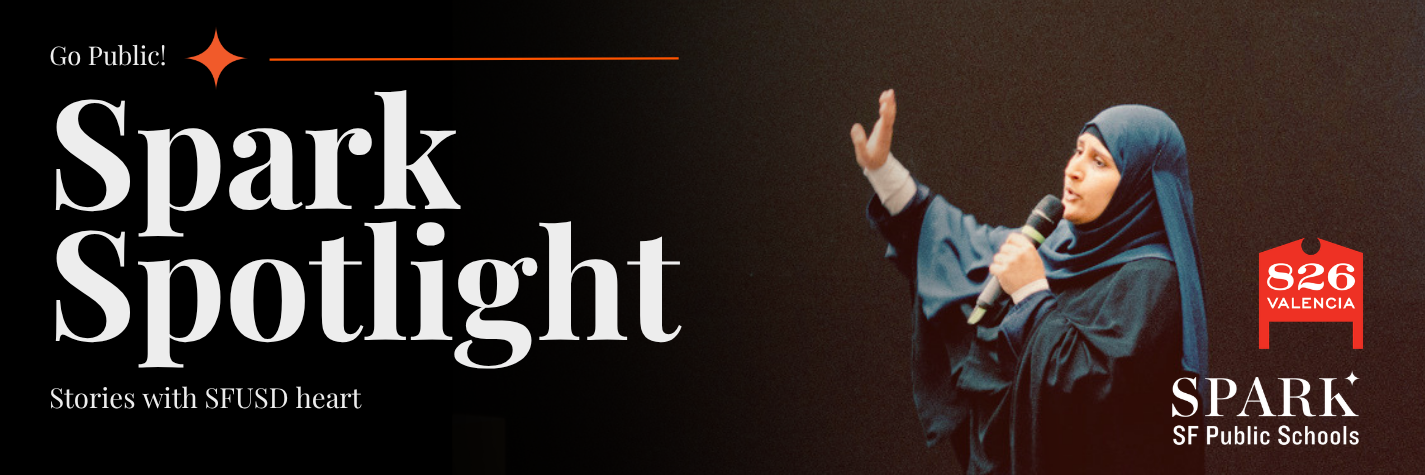
For the past three years, Spark has commissioned an original poem to be written and performed at the Superintendent's 21st Century Scholarship Award Ceremony. We are grateful to partner with 826 Valencia, the San Francisco nonprofit that helps under-resourced SFUSD students ages six to eighteen develop their writing and storytelling skills, to support each year's selected student poet.
When Rehan Meftah stepped up to perform at the 2026 Superintendent's 21st Century Scholarship Award Ceremony at the Asian Art Museum, she wasn't simply reading a poem. She was standing in her element, sharing her words with a captivated audience.
“My background doesn't define me — it strengthens me to keep going."
— Rehan Meftah, Spark’s 2026 Youth Poet Laureate
Rehan is Spark's 2026 Youth Poet Laureate. Her poetry explores identity, resilience, and hope—the same themes she found in the writers who inspired her, and the same ones that shape her own story as a young woman who came from a place where, as she puts it, education isn't open to everyone.
We hope you'll enjoy getting to know Rehan in the interview below—and, of course, take a moment to read the powerful poem she wrote for this year's ceremony.
Q: You describe education as a journey. What have been some of the milestones that mattered most?
A: Graduating high school and getting into a four-year college — because I know not everyone has access to education, or the chance to finish school. But what I value most are the connections. I had a really good relationship with my Spanish teacher, and she made me realize I want to become a teacher myself. I was always struggling with what I wanted to do, how to make my parents proud, and I realized what I strive for is purpose and change.
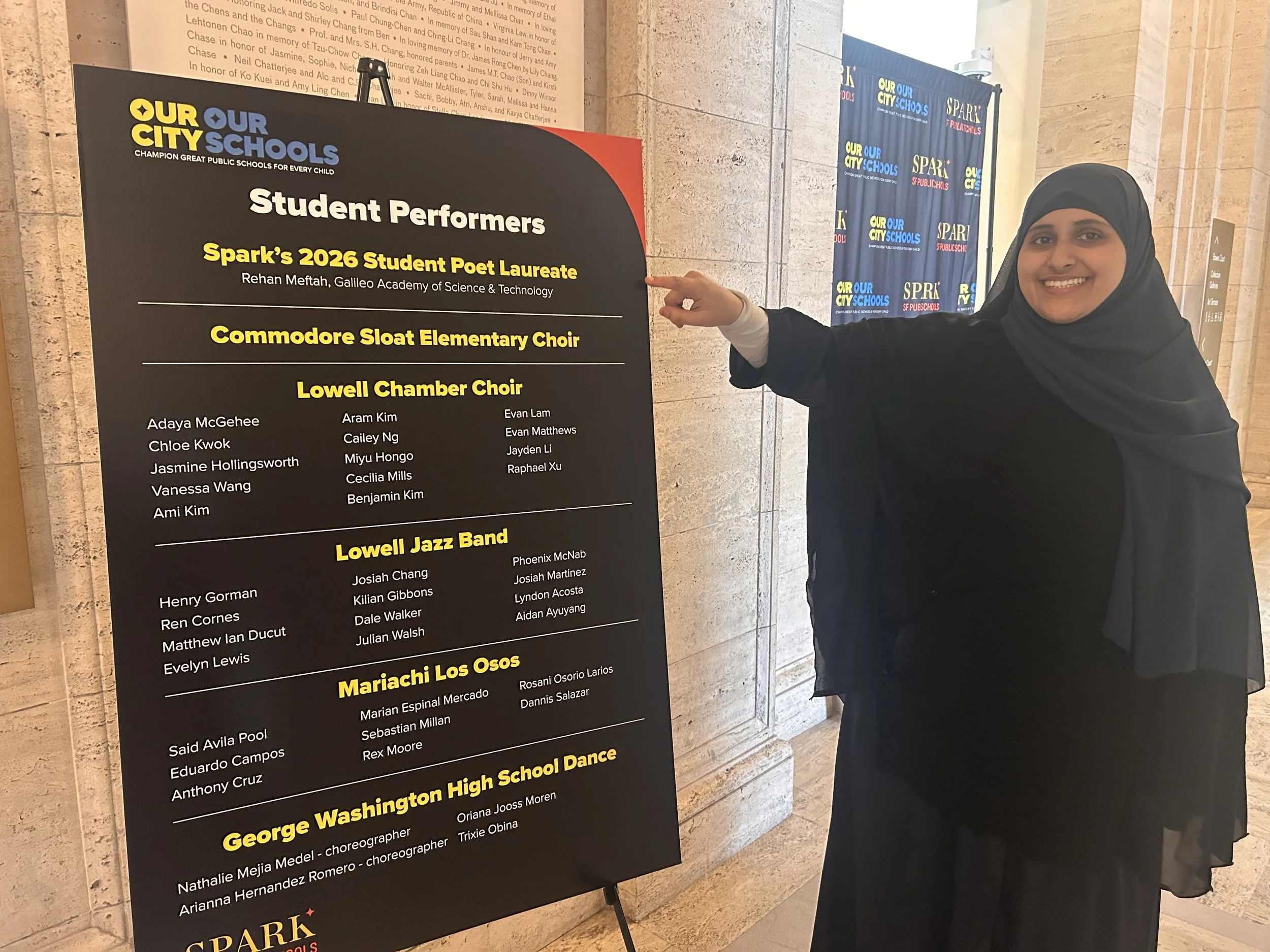
Rehan Meftah at Spark’s 2026 Our City, Our Schools gala
Q: Which writers have inspired you, and why?
Khaled Hosseini and Mahmoud Darwish. I read The Kite Runner during senior year — one of the best books I've ever read — and now I'm reading A Thousand Splendid Suns. The way Hosseini uses figurative language is so inspiring; his books relate to my own style and my purpose, which is to show emotion in my poems. And Mahmoud Darwish is a poet I can really relate to. My work is inspired by his — identity, resilience, hope, and so much more.
Q: You write, "We carry resilience and curiosity, shaping our dreams." Why is it important for you to stay curious?
There are so many things to learn about. Even if you're already passionate about a subject or set on a career, don't let that stop you from exploring — it helps you connect with others. Learning never ends, because everywhere we go, we might learn something new.
Q: Another line reads, "We learn together to achieve and accomplish / To break barriers and stereotypes." What barriers is education helping you address?
The biggest one is the idea that my background determines my future. People assume I can't accomplish certain things because I came from a country — Yemen — where education isn't affordable or open to everyone. A lot of women don't get the opportunity to pursue their education because of family responsibilities, or because some people believe women shouldn't. I learned to change that, to prove that my background doesn't define me — it strengthens me. I want to use my voice to advocate for people who are struggling, and to help make education about more than just a classroom.
Q: What was it like to perform your poem on that stage?
It was really great. I loved delivering my poem, because that's what I love to do. Everyone showed me so much love and support — I was really grateful for the opportunity.